For years, Rare Disease Access has been defined by three critical questions: Does a treatment exist? Is it approved? Will it be funded?
Today, those questions remain important, but they no longer tell the whole story.
Advances in genomics, new-born screening and rare disease regulation are enabling patients to be identified earlier than ever before. At the same time, highly specialised therapies are reaching the market at an accelerating pace.
The challenge is no longer simply gaining approval or securing reimbursement. Increasingly, the barrier is operational.
When a patient is diagnosed and a treatment exists, can the healthcare system, manufacturer and supply network deliver access quickly, compliantly and safely?
Across the rare disease landscape, scientific innovation is advancing faster than healthcare infrastructure.
Initiatives such as the Genomics England Generation Study, expanded newborn screening programmes and evolving regulatory frameworks are helping identify patients earlier and creating new opportunities for treatment intervention.
While this represents a significant step forward for patients, it also exposes a growing operational gap between diagnosis and treatment.
Healthcare professionals are increasingly aware of therapies that may not yet be available through local reimbursement pathways, may not be launched in their market, or may only be accessible through specialist programmes.
The result is a critical question:
- How can manufacturers ensure patients gain timely access to treatment when commercial and healthcare systems are not yet ready?
The future of Rare Disease Access will not be defined solely by scientific breakthroughs. It will be defined by how effectively healthcare systems, manufacturers and supply partners work together to turn diagnosis into treatment.

Understanding the Access Gap
Access challenges rarely stem from a single issue. Instead, they occur where three critical pathways interset:
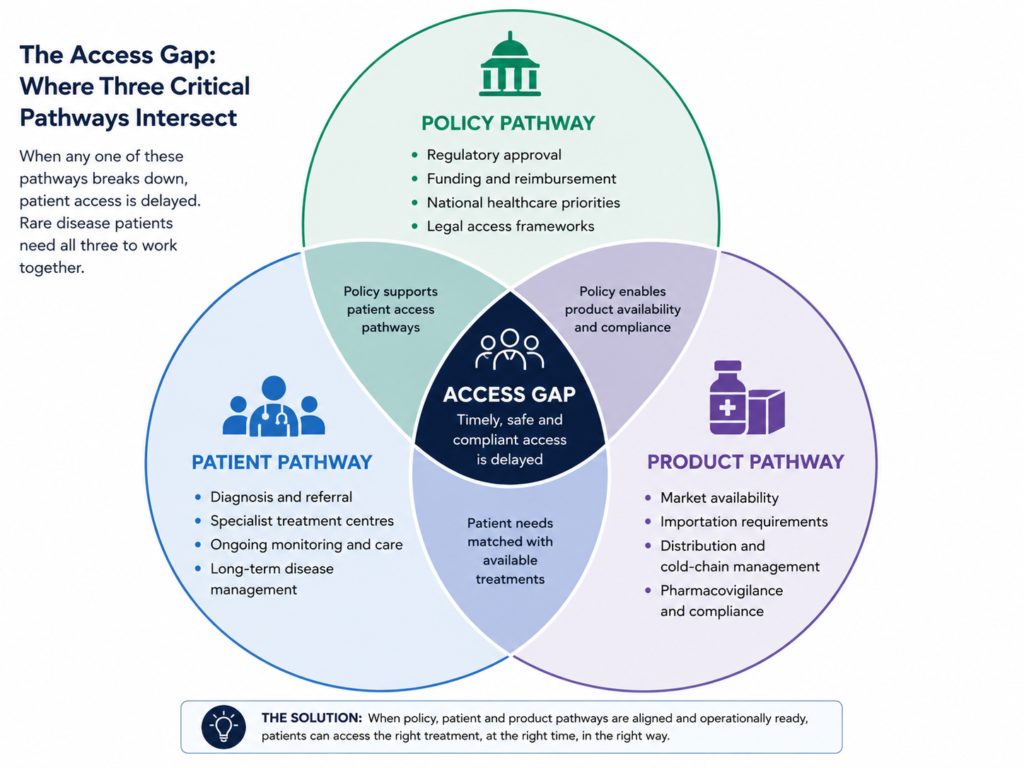
Policy Pathway
- Regulatory approval
- Funding and reimbursement
- National healthcare priorities
- Legal access frameworks
Patient Pathway
- Diagnosis and referral
- Specialist treatment centres
- Ongoing monitoring and care
- Long-term disease management
Product Pathway
- Market availability
- Importation requirements
- Distribution and cold-chain management
- Pharmacovigilance and compliance
When any one of these pathways breaks down, patient access is delayed.
This challenge becomes particularly acute in rare diseases, where patient populations are small, therapies are highly specialised and treatment continuity is critical.
The Operational Reality
We increasingly see situations where:
- A medicine is approved in one market but unavailable in another.
- Physicians become aware of promising therapies before local reimbursement pathways are established.
- Clinical trials conclude before commercial supply becomes available.
- Manufacturers receive requests from countries where no launch strategy currently exists.
In these scenarios, the issue is not whether demand exists. The issue is where there is an operational framework capable of responding to that demand. Without a structured approach, access becomes reactive, inconsistent and difficult to govern.
Bridging the Gap Through Managed Access
Managed Access Programmes, Named Patient Programmes, Compassionate Use Programmes and Post-Trial Access initiatives provide a critical bridge between patient need and healthcare system readiness.
When implemented correctly, these programmes provide:
- A compliant route for physician requests
- Clear governance and documentation
- Controlled importation and distribution
- Pharmacovigilance oversight
- End-to-end supply chain visibility
Rather than replacing commercial launch strategies, they create a controlled pathway that supports patients while broader access mechanisms are still developing.
Commercial Implications for Biotech and Pharma
The challenge is particularly relevant for rare disease and oncology companies.
Many emerging biopharma organisations focus resources on a primary launch market while maintaining limited infrastructure elsewhere. However, physician demand rarely follows commercial launch timelines.
Rare disease communities are highly connected, informed and proactive. Once clinical data becomes public and regulatory milestones are achieved, demand frequently emerges from markets well beyond the initial launch geography.
Organisations therefore need clear answers to questions such as:
- Which countries are most likely to generate early demand?
- Which patients will require post-trial continuity of treatment?
- Where are launch timelines likely to be delayed?
- Which markets support Named Patient access pathways?
- What regulatory and supply chain requirements must be met?
Supporting Access Readiness
As therapies become more specialised and access pathways increasingly complex, manufacturers require more than a route to supply. They need confidence that patient access can be managed in a controlled, compliant and operationally robust manner.
Supporting access readiness requires a combination of regulatory understanding, programme governance, supply chain expertise and patient-focused execution.
BAP Pharma helps pharmaceutical and biotechnology companies navigate this complexity through four key areas:
Regulatory & Market Feasibility
Assessing country-specific access pathways, import requirements and regulatory considerations to determine where and how treatment can be supplied compliantly.
Governance & Programme Oversight
Supporting the management of physician requests, documentation workflows and programme controls to ensure access is delivered within a clearly defined framework.
End-to-End Supply Chain Management
Coordinating sourcing, storage, distribution and specialised logistics to maintain product integrity and continuity throughout the patient journey.
Pharmacovigilance & Compliance Support
Helping ensure appropriate safety reporting, traceability and oversight are maintained throughout the access programme lifecycle.
By bringing these elements together, manufacturers can respond to patient need with greater confidence, visibility and control, while maintaining the standards required to support safe and compliant access.
Key Takeaway
The earlier these questions are addressed, the greater the ability to respond confidently and compliantly.
The future of rare disease access will not be determined solely by the therapies that are developed, approved or funded.
It will be determined by how effectively healthcare systems, manufacturers and access partners work together to ensure those therapies reach patients safely, compliantly and at the moment they are needed.
As diagnosis accelerates and access pathways become increasingly complex, operational readiness is emerging as a critical differentiator.
Because for patients waiting for treatment, access is not a policy decision or a commercial milestone.
It is the ability to turn scientific innovation into action.
And that requires certainty at every step.
Manufacturers are increasingly recognising that operational readiness is just as important as commercial readiness.